By Edidiong Udoh
The Next Frontier of Innovation
Innovation no longer happens in isolation. Startups, fabrication labs, research institutions, and digital platforms are increasingly interdependent, forming what we can call tech-enabled innovation ecosystems. In emerging markets, these ecosystems are still nascent but hold immense potential. The difference between a fragmented startup scene and a thriving innovation ecosystem is structure, connectivity, and access to resources. Those regions that intentionally cultivate these networks stand to accelerate growth, improve resilience, and attract talent and investment simultaneously.
Core Components of Innovation Ecosystems
A successful innovation ecosystem requires more than ideas; it requires the deliberate alignment of multiple layers. These include:
Physical infrastructure: workspaces, labs, and fabrication facilities equipped with modern tools.
Digital infrastructure: platforms for collaboration, data-sharing, and remote coordination.
Financial infrastructure: access to grants, seed funding, venture capital, and alternative financing models.
Human capital ecosystem: pipelines of talent with skills aligned to the demands of modern technology and innovation.
Without this alignment, promising projects often stall. Labs may exist but remain underutilised, talent may leave for better opportunities elsewhere, and capital may flow unevenly, favouring visible startups over the broader network. A structured ecosystem ensures that innovation is not only possible but sustainable.
The Role of Technology in Coordination
Digital platforms serve as both the glue and the accelerator of innovation ecosystems. Cloud-based project management tools, collaborative design software, and real-time dashboards enable teams to coordinate across geographies. Open-source communities allow knowledge-sharing, accelerating the learning curve for hardware and software development. Emerging tools in AI, IoT, and blockchain further enhance an ecosystem’s ability to:
— Manage complex operations efficiently.
— Predict trends and market shifts.
— Optimise resource allocation.
Technology does not replace the work being done in labs or workshops; it orchestrates it, making distributed teams function cohesively as a single system.
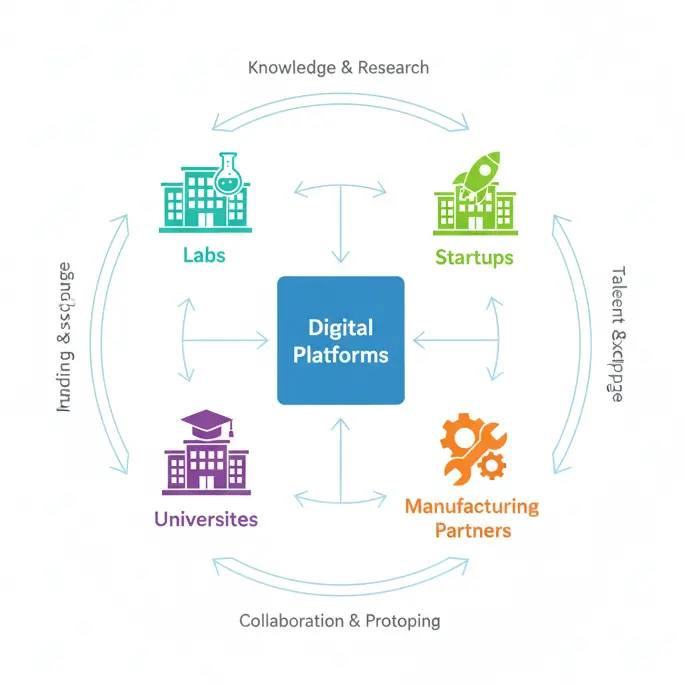 Image 1: Innovation ecosystem map
Energy and Sustainability as Foundational Pillars
Just as in distributed industrial clusters, energy and sustainability underpin resilient innovation ecosystems. Workspaces, labs, and research centres must operate reliably to maintain productivity. Hybrid energy systems combining solar arrays, battery storage, and grid integration provide the stability necessary for consistent operations. Beyond reliability, sustainable practices:
— Reduce operational costs.
— Attract investment.
— Enhance public perception.
When energy systems are stabilised and sustainability is embedded into operations, innovation ecosystems can scale efficiently with lower risk.
Nurturing Human Capital
At the heart of any ecosystem is its people. Entrepreneurs, engineers, designers, technicians, and researchers form the core. Skill development must be structured, continuous, and aligned with the ecosystem’s objectives. Mentorship programs, internship pipelines, and collaborative projects create environments where knowledge is shared, talent is retained, and capacity grows organically. Human capital transforms infrastructure into impact, turning isolated innovation into systemic progress.
Financing Innovation: Beyond Grants
While grants are important, ecosystems thrive when financing is multi-layered. A diverse financial ecosystem allows smaller innovators to participate and ensures risk is distributed. Funding options can include:
— Seed investment for early-stage projects.
— Angel investment for higher-risk experimentation.
— Revenue-based financing is tied to performance.
— Grants and challenge funds for socially impactful innovations.
When financing is inclusive, ecosystems become more diverse, robust, and capable of sustaining long-term growth.
Measuring Success
Metrics for innovation ecosystems extend beyond output like patents or prototypes. Success is also measured by adaptability and resilience. Key indicators can include:
— Network density and collaboration frequency.
— Skills development and talent retention.
— Resource utilisation efficiency.
— Capacity to pivot in response to challenges.
A robust monitoring framework ensures that the ecosystem can learn, adapt, and grow continuously, rather than stagnate despite surface-level successes.
Future Opportunities
Emerging markets are uniquely positioned to leapfrog traditional development paths. With access to affordable technology, growing digital connectivity, and young talent pools, innovation ecosystems can take off rapidly. Potential high-impact areas include:
— Decentralised manufacturing networks that shorten supply chains.
— AI-enabled agrotech solutions are improving food production efficiency.
— Renewable energy microgrids supporting resilient infrastructure.
— Healthcare innovations using digital platforms and local fabrication.
The next decade will favour regions that integrate physical, digital, and human elements into cohesive ecosystems.
ConclusionThe ecosystems that flourish in emerging markets will not emerge by chance. They must be deliberately built: interconnected, energy-resilient, digitally coordinated, and human-centric. Regions that understand and invest in this holistic model of innovation will not only generate breakthroughs but also shape the industrial, technological, and entrepreneurial landscape for decades to come.