Edidiong Udoh
A New Industrial Paradigm
For decades, industrialisation followed a predictable script: massive factories, centralised production zones, and heavy infrastructure concentrated in one location. This model powered global supply chains and defined industrial success in the 20th century. But the 21st century is quietly rewriting that structure. Across emerging markets, the next wave of industrial growth may not revolve around megafactories at all. Instead, it will centre on distributed industrial clusters — smaller, specialised production hubs linked through digital coordination, shared standards, and regional collaboration. What makes this model especially compelling is its practicality: it allows regions to industrialise without waiting for perfect infrastructure or massive capital investment.
The Limits of Centralised Industrialisation
Traditional large-scale industrialisation is notoriously difficult to replicate in contexts where infrastructure is still developing. Centralised factories require enormous upfront investment in land, power, transport corridors, water systems, regulatory coordination, and long-term capital stability. Even when these are in place, the concentration of operations creates risk. A single disruption — whether from power outages, transport delays, or political instability — can halt entire supply chains. Recent global shocks exposed this vulnerability, underscoring a simple truth: resilience is built through distribution, not concentration.
Defining Distributed Industrial Clusters
A distributed industrial cluster is not a random scattering of workshops. It is a deliberately coordinated network of specialised production nodes that operate semi-independently while maintaining shared standards. Each node focuses on specific stages of production — one hub may specialise in precision cutting, another in electronics assembly, and yet another in packaging and finishing. Coordination happens digitally, through shared production schedules, inventory tracking, and quality control systems. This modular approach allows for flexibility: disruptions at one node do not halt the entire network, and expansion occurs naturally by adding new specialised units.
Adapting to Local Realities
The distributed cluster model aligns perfectly with realities already present in many African markets. Small fabrication workshops, independent metalworkers, electronics repair hubs, and artisan manufacturing clusters exist in abundance, but they often operate in isolation. With stable energy systems, reliable logistics, and digital coordination tools, these fragmented producers can evolve into organised clusters capable of taking on complex production tasks. The principle is not to copy large industrial systems from other regions but to adapt the concept of coordination, modularity, and resilience to local realities. The result is a production ecosystem that is both scalable and grounded in community-level capabilities.
Energy: The Foundational Layer
Energy is the foundation of this evolution. Distributed production networks rely on reliable power to operate consistently, and hybrid systems combining solar, battery storage, and grid integration provide that stability. When each production node has its own energy autonomy, the cluster as a whole gains resilience. Interruptions at the macro-grid level no longer translate into operational shutdowns, allowing production schedules to remain predictable. This integration of energy stability and industrial activity transforms small-scale workshops into reliable contributors to larger production networks.
Digital Coordination and Collaboration
Digital coordination complements physical infrastructure. Cloud-based platforms now allow small production hubs to synchronise output, manage orders, and maintain quality standards in real time. Digital tools reduce the friction that once necessitated physical proximity, enabling even geographically dispersed nodes to operate as part of a cohesive system. Software does not replace the tangible production work; it orchestrates it, ensuring that modular units function efficiently and collectively.
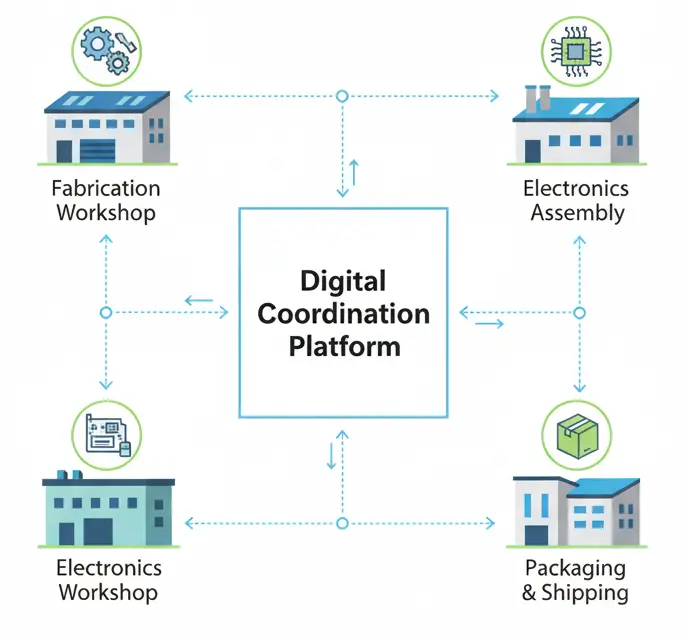 Image 1: Connected industrial nodes with digital coordination
Economic Impacts and Skill Development
The economic impact of well-structured distributed clusters can be significant. By retaining more production stages locally, regions can capture greater value from the products they manufacture. Skills develop faster when production nodes operate with real-world constraints and opportunities, and supply chains shorten as local networks replace inefficient long-distance dependencies. Over time, these clusters specialise further, improving quality and competitiveness while fostering technical knowledge and innovation within the community. The compounding effects reinforce both economic growth and workforce capability.
Risk Distribution as Strategic Advantage
One of the most strategic advantages of distributed clusters is risk distribution. Unlike centralised factories, where a single failure can halt operations, modular networks absorb shocks. If one production node faces disruption, others can adjust and compensate. In a global context characterised by climate variability, geopolitical shifts, and supply chain volatility, distributed clusters are not just efficient — they are resilient by design. This capacity to absorb and adapt to disruptions gives regions a competitive advantage, allowing them to maintain production continuity when conventional systems would fail.
Building a Skills Pipeline
For these clusters to thrive, a robust skills pipeline is essential. Technical education, vocational training, and apprenticeships must align with the needs of modern production tools and practices. Precision manufacturing, electronics assembly, and digital fabrication all require depth of skill that cannot be improvised. When training systems integrate with production networks, the clusters become more than temporary economic fixes; they evolve into long-term innovation ecosystems capable of self-sustaining growth and local problem-solving.
A Scalable and Adaptive Vision
Distributed industrial clusters offer a fundamentally different vision of industrial growth. They show that industrialisation need not begin with billion-dollar zones or massive government-led projects. It can start with stabilised workspaces, coordinated production nodes, and energy-resilient systems. This model is scalable without being brittle, local without being isolated, and connected without being overconcentrated. In essence, distributed clusters provide a pathway to industrial growth that is adaptive, practical, and resilient — precisely what many emerging markets need to leapfrog traditional limitations.
Final Thought: Modularity as the Future
The industrial future of emerging markets may not mirror the past of industrial giants. Instead, it will be modular, networked, and adaptive, combining energy resilience, digital coordination, and skilled human capital. The key question for policymakers, entrepreneurs, and innovators is not whether distributed clusters will emerge — they already are in various informal forms — but whether they will be intentionally designed, coordinated, and supported. The regions that seize this opportunity will anchor industrial growth locally while building resilience against global disruptions. In a world where scale and adaptability are increasingly intertwined, distributed industrial clusters may well define the next chapter of industrialisation in Africa.
Adapting to Local Realities
Digital Coordination and Collaboration
Economic Impacts and Skill Development
Risk Distribution as Strategic Advantage
Building a Skills Pipeline
A Scalable and Adaptive Vision
Final Thought: Modularity as the Future