By Edidiong Udoh
There is a recurring pattern in technology discourse across emerging markets: we celebrate visible innovation while underinvesting in invisible systems.
We praise apps before stabilising power.
We scale platforms before strengthening logistics.
We discuss artificial intelligence before securing reliable compute infrastructure.
But innovation cannot float indefinitely above weak foundations.
Every digital success story rests on a physical layer that is often ignored until it fails.
Across Africa, the most consequential transformation over the next decade will not be cosmetic digital expansion. It will be infrastructural maturity. And that maturity will determine which industries accelerate and which plateau.
The uncomfortable truth is this: infrastructure is not optional. It is sequential.
Digital Growth Has a Physical Ceiling
It is easy to assume that software-driven economies can leapfrog structural limitations. To some extent, that has been true. Mobile banking scaled in regions with limited traditional banking infrastructure. E-commerce platforms emerged despite fragmented retail systems.Yet every leap eventually hits resistance.Fintech depends on stable telecommunications networks.
Cloud services depend on data centres.
Remote work depends on electricity stability.
Manufacturing tech depends on precision hardware and steady power.
When infrastructure becomes inconsistent, digital growth slows. Not dramatically at first, but predictably.
This is not theory.
It is systems logic.
Globally, major technology ecosystems did not emerge independently of infrastructure investment. The growth of Silicon Valley coincided with deep research investment anchored by institutions like Stanford University, and the scaling of global cloud platforms relied heavily on hyperscale infrastructure developed by companies such as Amazon Web Services.
Software ecosystems mature where infrastructure quietly supports them.
The same principle applies anywhere.
Energy: The First Constraint
Among all infrastructure layers, energy is foundational.
Without consistent electricity, productivity fragments. Equipment degrades. Operational planning becomes speculative.
In many emerging markets, businesses have already adapted through hybrid power systems. Solar installations, inverter banks, and distributed generation models are no longer experimental, they are operational necessities.
According to the World Bank, energy access remains one of the most critical enablers of economic expansion in developing regions. The linkage between reliable power and small business growth is not abstract; it is measurable.
When electricity stabilises, output stabilises. When output stabilises, investment confidence improves.
Energy is not just a utility line item. It is an economic multiplier.
Logistics: The Silent Accelerator
After energy comes movement.
Digital marketplaces promise nationwide reach, but physical goods must still travel. Roads, ports, warehousing systems, and last-mile delivery networks determine whether commerce is efficient or expensive.
Infrastructure inefficiencies raise the cost of participation. Small producers struggle to access broader markets. Delivery unpredictability erodes trust.
This is why logistics innovation, from route optimisation software to decentralised storage hubs, becomes transformative only when supported by tangible physical systems.
Without coordinated infrastructure, growth remains uneven.
Manufacturing: The Missing Middle
Perhaps the most overlooked infrastructure layer is light manufacturing capability.
Many economies export raw materials and import finished products. This structural gap limits value capture and constrains domestic industrial growth.
However, modern manufacturing does not require massive industrial zones to begin. Modular fabrication labs, distributed assembly units, and specialised production clusters can serve as intermediate steps.
The rise of accessible rapid prototyping tools has lowered entry barriers globally. What remains critical is ecosystem support: stable power, training pipelines, and predictable supply chains.
When manufacturing maturity increases, innovation becomes more self-sustaining. Hardware solutions can be designed, tested, refined, and scaled locally rather than outsourced entirely.
This shortens feedback loops. It strengthens capability.
Data Infrastructure and the New Economy
As economies digitise, data infrastructure becomes increasingly strategic.
Data centres, edge computing nodes, fibre connectivity — these are not abstract technical terms. They determine latency, reliability, and digital competitiveness.
Across the continent, regional data hubs are expanding, and investment in digital infrastructure is accelerating. While still uneven, the trajectory suggests recognition that data sovereignty and compute reliability are no longer optional.
Artificial intelligence, automation, and advanced analytics cannot operate consistently without underlying compute stability.
The infrastructure layer must catch up with ambition.
Why Skipping Steps Is Risky
There is a temptation in fast-growing markets to prioritise visible innovation over foundational systems. Headlines gravitate toward startups, funding rounds, and app launches.
Infrastructure work is slower. Less glamorous. Politically complex.
But skipping steps creates fragility.
A rapidly digitising economy built on unstable power and inconsistent logistics resembles a high-rise built on shallow foundations. It may stand for a while. But stress eventually reveals structural weaknesses.
Sequencing matters.
Digital acceleration and infrastructure investment must move in parallel.
The Compounding Effect of Getting It Right
When infrastructure matures, the effect compounds.
Reliable power reduces operational risk.
— Improved logistics lowers transaction friction.
— Stronger manufacturing ecosystems increase value retention.
— Robust data infrastructure enhances digital competitiveness.
Each layer reinforces the others and over time, this creates a self-reinforcing growth cycle.Innovation becomes less reactive and more strategic.
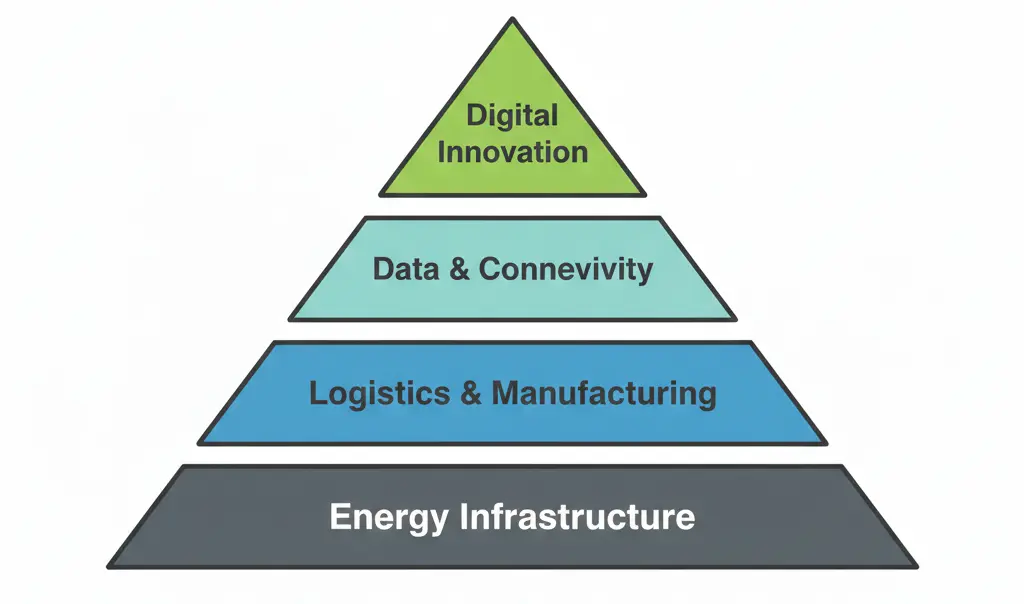
Image 1: Innovation pyramid supported by infrastructure layers
A Decade of Infrastructure Decisions
The next ten years will be shaped by infrastructure decisions made quietly today.
— Where energy reliability improves, productivity will rise.
— Where logistics networks strengthen, commerce will expand.
— Where manufacturing capabilities deepen, innovation will localise.
— Where data infrastructure stabilises, advanced technologies will scale sustainably.
The opportunity is not merely to adopt global trends. It is to build structural capacity that supports them.
This is slower work. But it is decisive work.
The Strategic Reframe
Rather than asking how quickly digital products can scale, a more powerful question might be: what foundational systems must exist to support that scale sustainably?
Infrastructure is not the opposite of innovation. It is its prerequisite.
The economies that recognise this and invest accordingly will not just participate in global digital growth. They will anchor it locally.
Skipping infrastructure may feel efficient.
Building it deliberately is transformative.
Across Africa, the most consequential transformation over the next decade will not be cosmetic digital expansion. It will be infrastructural maturity. And that maturity will determine which industries accelerate and which plateau.
When infrastructure becomes inconsistent, digital growth slows. Not dramatically at first, but predictably.
It is systems logic.
Globally, major technology ecosystems did not emerge independently of infrastructure investment. The growth of Silicon Valley coincided with deep research investment anchored by institutions like Stanford University, and the scaling of global cloud platforms relied heavily on hyperscale infrastructure developed by companies such as Amazon Web Services.
According to the World Bank, energy access remains one of the most critical enablers of economic expansion in developing regions. The linkage between reliable power and small business growth is not abstract; it is measurable.
The Strategic Reframe