By Edidiong Udoh
Reliable power is not a luxury for modern workspaces. It is infrastructure.
Whether it’s a fabrication lab, a small production workshop, a design studio, or a training centre, unstable electricity directly affects output, equipment lifespan, and revenue predictability.
In many emerging markets, grid inconsistency is a known constraint. But instead of treating it as a temporary inconvenience, resilient builders design around it.
Energy-resilient workspaces are not accidental. They are engineered.
This article outlines a practical framework for designing one.
Step 1: Start With a Load Reality Audit
Before buying a single panel or an inverter, you need clarity.
List every electrical device in the workspace:
CNC machines, 3D printers, Desktop computers, Lighting systems, Ventilation, Soldering stations, Battery chargers, Refrigeration (if applicable).For each device, document:
— Rated wattage
— Startup surge requirement
— Daily usage hours
This produces your true operational load, not a guess.
Most resilience failures happen because systems are undersized or miscalculated.
A 5kVA inverter sounds sufficient — until two high-surge devices start simultaneously. Precision matters.
Step 2: Separate Critical From Non-Critical Loads
Not all equipment needs backup power.
Classify devices into two groups:
Critical Systems
— Core machinery
— Primary computers
— Network infrastructure
— Essential lighting
Non-Critical Systems
— Decorative lighting
— Air conditioning (in some cases)
— Secondary equipmentDesign your backup system to sustain critical loads first.
This reduces system size requirements and extends battery runtime during outages.
Energy resilience is about priority, not perfection.
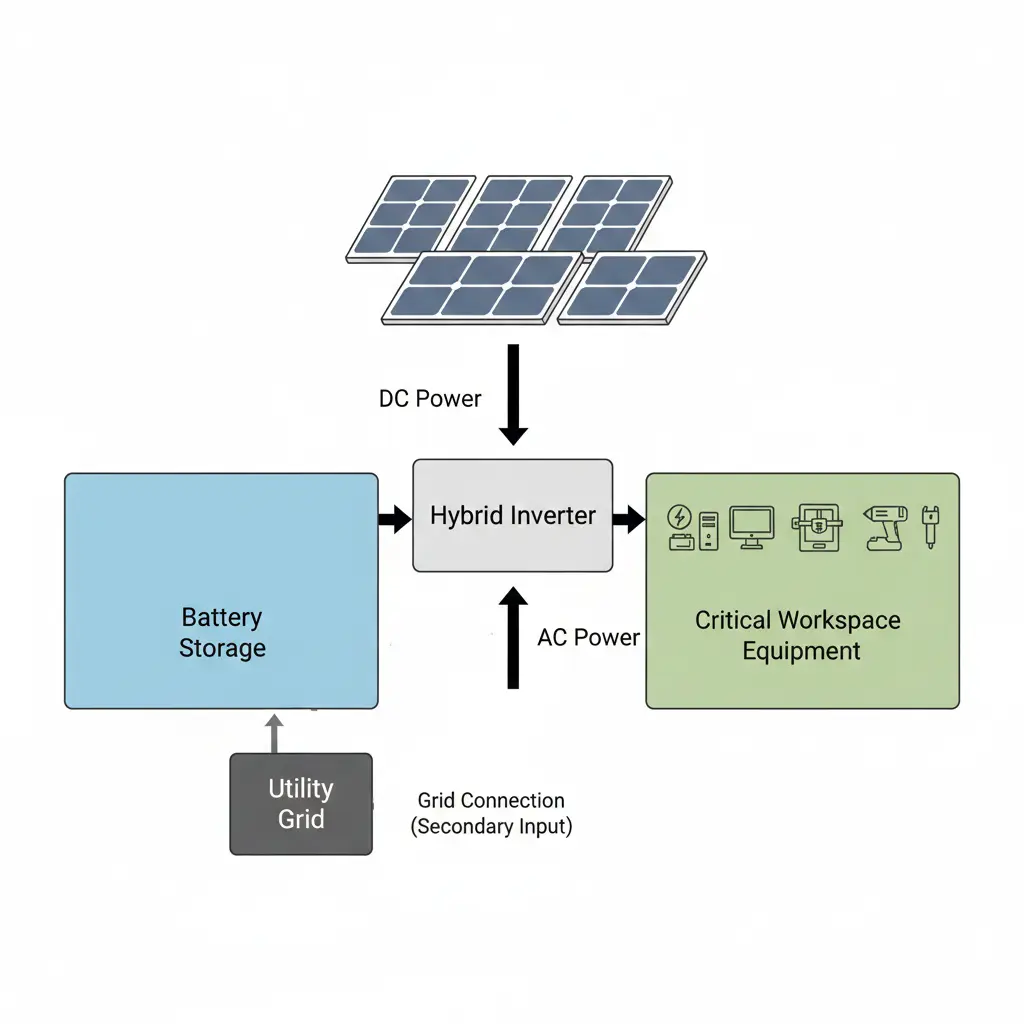
Step 3: Adopt a Hybrid Energy Model
Full grid independence is expensive, total grid reliance is risky. The middle ground is hybrid.
A resilient workspace typically combines:
Grid input, Solar generation, Battery storage, and Smart load management.Solar reduces daytime dependency.
— Batteries smooth fluctuations.
— The grid becomes supplemental rather than primary.
This layered model improves predictability.
Globally, hybrid systems have become standard in off-grid and weak-grid regions. Organisations like the International Renewable Energy Agency consistently highlight distributed renewable systems as scalable resilience tools in developing markets.
The model is proven, the question is execution.
Step 4: Design for Surge and Scalability
Many workspaces grow.
A lab that begins with two machines may scale to six within 18 months.If your system cannot expand, you will replace it prematurely.
Choose:
— Inverters that allow parallel expansion
— Modular battery banks
— Mounting structures with room for additional panels
Designing for scale reduces long-term cost. Resilience is future-proofing.
Step 5: Stabilise Power Quality
Outages are only one problem. Voltage instability damages sensitive electronics.Fluctuations shorten the lifespan of:
CNC controllers, Power supplies and Computing hardware Installing automatic voltage regulators (AVRs) or inverter systems with built-in stabilisation protects capital equipment. The cost of prevention is lower than replacement.
Step 6: Monitor Energy in Real Time
If you cannot measure it, you cannot optimise it.
Modern inverter systems provide:
— Consumption analytics
— Load history
— Battery health monitoring
— Generation tracking
Energy dashboards allow operators to adjust usage patterns strategically.
For example:
If peak consumption occurs at midday, align high-draw activities with peak solar generation.
Operational intelligence improves efficiency.
Step 7: Consider Human-Integrated Systems (Optional)
In certain contexts: schools, training centres, community labs, human-powered generators can supplement energy systems.
While not primary sources, they can:
Support low-draw equipment
Serve educational purposes
Encourage energy awareness
Integrated thoughtfully, these systems reinforce a sustainability culture.
They are complementary, not replacements.
Step 8: Budget Beyond Installation
Energy systems fail when maintenance is ignored.
Budget for:
— Battery replacement cycles
— Panel cleaning
— Cable inspections
— Firmware updates
A resilient workspace includes a maintenance schedule, not just equipment.
Step 9: Design the Physical Layout Intentionally
Energy infrastructure should not feel like an afterthought.
Plan for:
— Proper ventilation for batteries
— Secure inverter mounting
— Clear cable routing
— Fire safety measures
— Access for maintenance
Cluttered installations increase risk, engineering discipline extends beyond circuitry.
What Resilience Really Means
Energy resilience is not about eliminating outages.
It is about reducing operational disruption to acceptable limits.
For a fabrication lab, that might mean:
— Zero downtime for design computers
— Minimal interruption to production cycles
— Protection of sensitive electronics
For a training center, it might mean:
— Continuous lighting
— Stable internet
— Reliable projection systems
Define success before building the system.
The Strategic Advantage
Workspaces designed with energy resilience to operate more predictably, protect equipment investment, improve client confidence and attract serious collaborators.Reliability signals professionalism. In emerging markets, consistency is a competitive advantage.
Final Thought
Waiting for perfect infrastructure is not a strategy.
Designing around current realities is.
Energy-resilient workspaces are not extravagant upgrades. They are structural decisions that unlock productivity.
The grid may improve over time.
But builders who plan for resilience today will not be forced to pause tomorrow.
Reliable power is not a luxury for modern workspaces. It is infrastructure.
Step 2: Separate Critical From Non-Critical Loads
Not all equipment needs backup power.
Classify devices into two groups:
Critical Systems
— Core machinery
— Primary computers
— Network infrastructure
— Essential lighting
Non-Critical Systems
— Decorative lighting
— Air conditioning (in some cases)
— Secondary equipment
Design your backup system to sustain critical loads first.
This reduces system size requirements and extends battery runtime during outages.
Energy resilience is about priority, not perfection.
Step 3: Adopt a Hybrid Energy Model
Full grid independence is expensive, total grid reliance is risky. The middle ground is hybrid.
A resilient workspace typically combines:
Grid input, Solar generation, Battery storage, and Smart load management.
Solar reduces daytime dependency.
— Batteries smooth fluctuations.
— The grid becomes supplemental rather than primary.
This layered model improves predictability.
Globally, hybrid systems have become standard in off-grid and weak-grid regions. Organisations like the International Renewable Energy Agency consistently highlight distributed renewable systems as scalable resilience tools in developing markets.
The model is proven, the question is execution.
Many workspaces grow.
A lab that begins with two machines may scale to six within 18 months.
A lab that begins with two machines may scale to six within 18 months.
If your system cannot expand, you will replace it prematurely.
Choose:
— Inverters that allow parallel expansion
— Modular battery banks
— Mounting structures with room for additional panels
Designing for scale reduces long-term cost. Resilience is future-proofing.
Step 5: Stabilise Power Quality
Outages are only one problem. Voltage instability damages sensitive electronics.
Fluctuations shorten the lifespan of:
CNC controllers, Power supplies and Computing hardware
Installing automatic voltage regulators (AVRs) or inverter systems with built-in stabilisation protects capital equipment. The cost of prevention is lower than replacement.
For example:
Step 7: Consider Human-Integrated Systems (Optional)
Step 6: Monitor Energy in Real Time
If you cannot measure it, you cannot optimise it.
Modern inverter systems provide:
— Consumption analytics
— Load history
— Battery health monitoring
— Generation tracking
Energy dashboards allow operators to adjust usage patterns strategically.
For example:
If peak consumption occurs at midday, align high-draw activities with peak solar generation.
Operational intelligence improves efficiency.
Step 7: Consider Human-Integrated Systems (Optional)
In certain contexts: schools, training centres, community labs, human-powered generators can supplement energy systems.
While not primary sources, they can:
Support low-draw equipment
Serve educational purposes
Encourage energy awareness
Integrated thoughtfully, these systems reinforce a sustainability culture.
They are complementary, not replacements.
Step 8: Budget Beyond Installation
Energy systems fail when maintenance is ignored.
Budget for:
— Battery replacement cycles
— Panel cleaning
— Cable inspections
— Firmware updates
A resilient workspace includes a maintenance schedule, not just equipment.
Step 9: Design the Physical Layout Intentionally
Energy infrastructure should not feel like an afterthought.
Plan for:
— Proper ventilation for batteries
— Secure inverter mounting
— Clear cable routing
— Fire safety measures
— Access for maintenance
Cluttered installations increase risk, engineering discipline extends beyond circuitry.
What Resilience Really Means
For a training center, it might mean:
What Resilience Really Means
Energy resilience is not about eliminating outages.
It is about reducing operational disruption to acceptable limits.
For a fabrication lab, that might mean:
— Zero downtime for design computers
— Minimal interruption to production cycles
— Protection of sensitive electronics
For a training center, it might mean:
— Continuous lighting
— Stable internet
— Reliable projection systems
Define success before building the system.
The Strategic Advantage
Workspaces designed with energy resilience to operate more predictably, protect equipment investment, improve client confidence and attract serious collaborators.
Reliability signals professionalism. In emerging markets, consistency is a competitive advantage.
Final Thought
Waiting for perfect infrastructure is not a strategy.
Designing around current realities is.
Energy-resilient workspaces are not extravagant upgrades. They are structural decisions that unlock productivity.
The grid may improve over time.
But builders who plan for resilience today will not be forced to pause tomorrow.